
Vineyard posts and anchors
A trellis row is a load path.
Buying guide: End posts and line posts are not the same part
A trellis row is a load path. Every wire in the row pulls on the two end posts, and the line posts only hold that wire at the right height. Specify them as two different parts and the row stays straight for twenty years and more.
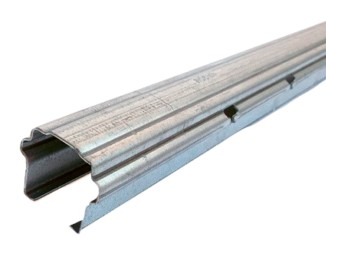
The end post carries the sum of every wire in the row, plus the crop load and the wind. It is the part that fails first when a row is under-specified, and the most expensive to replace, because the whole row has to come down to change it. The line post carries the wire and the vine, not the tension, which is why it can be lighter on a long row. That difference is where the cost of a trellis is actually won or lost.
In practice that means two specifications. Line posts get a lighter section driven at a regular spacing; end posts get a heavier section set deeper and braced with an anchor. Sending the row length, the number of wires and the wind load with your enquiry is enough for us to tell you which section we would use.
Anchors turn an end post into a fixed point
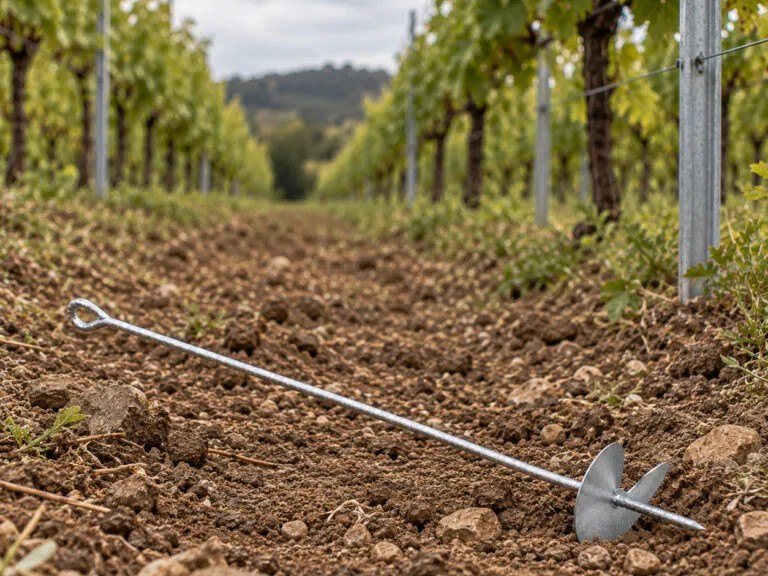
An end post on its own is a lever standing in the soil, and wire tension is pushing on the long end. A screw-in anchor takes that load into undisturbed ground behind the post and holds the post upright. It is quicker than a concrete deadman, it works on a slope where a concrete block would need a crane, and it can be retrofitted to a row that is already failing.
We make the anchors on our own machines, so the rod length, the helix diameter and the head can follow your bracket instead of you adapting your bracket to a catalogue part.
What you can specify on a post
Shape, length, hooking and galvanized coating are all made to your order rather than picked from a list. Wire is held either on a hooked top, through a punched hole or in a notch: hooked posts let the wire be lifted and dropped without unthreading, punched posts hold a fixed height and are quicker to run. The hole pattern, the spacing and the direction can follow your drawing or a sample you send us.
Tell us the row length, the wire count and the terrain, and we will come back with the section, the hooking and the anchor that fit that row. That is a shorter conversation than picking a post by diameter and hoping.
Common questions
What is the difference between an end post and a line post?
The end post takes the total tension of every wire in the row and needs anchoring; the line post only holds the wire at height and can be a lighter section. In a specified trellis they are two different parts, not one part used twice.
Can posts be punched or hooked to our drawing?
Yes. Hooking, notching, punching and the hole pattern are tooled at our factory in Jinhua, and we work from a drawing or from a physical sample.
Do we need anchors or concrete?
A driven line post relies on soil friction. Rock, shallow topsoil or a sandy profile usually calls for an anchor or a concrete-set end post rather than a larger driven one, because the failure is in the soil, not in the steel.
What determines the post length?
The planting depth plus the wire heights you need above ground, with an allowance for the hooking. Send the wire heights and the soil type and we will confirm the length rather than assume one.
How are posts and anchors packed for export?
Packing and container load depend on length and section, so both are quoted together with the price on every enquiry. We do not quote a price without the packing behind it.